
Capital decision analysis / Foreclosure, value, and the capital record
100 Summer Street
Rockpoint paid $806 million for the tower in 2019, weeks before COVID. The city now assesses it below the mortgage taken out to buy it, and Wells Fargo is auctioning it.
An independent study of public sources. Rockpoint Group and Wells Fargo Bank are parties studied, not clients. No advisory relationship is implied. Sections labeled My read are my interpretation, not the parties' account of their internal decisions.
This analysis aggregates the public record on the foreclosure: the auctioneer's own listing and calendar, the trade press that reported the sale and the value slide, the city's assessment reporting, and the building's energy filings. Rockpoint and Wells Fargo are parties studied, never clients of the author. Interpretation is marked below.
The figures establish a disclosed record to investigate. They do not establish a complete engineering account of the tower, and no capital figure is inferred from them anywhere in this article.
The bottom line up front
Rockpoint paid $806 million for 100 Summer Street in October 2019, weeks before COVID reached the United States, and borrowed $470 million of the price from Wells Fargo. [3] [4] The tower that was about 95 percent leased in 2018 is 72 percent leased today, per the auction notice. [6] [8] The city's assessments have followed the occupancy down, from $529 million to $488.6 million to about $425 million, below the mortgage as originated. [3] [8] Wells Fargo has foreclosed, and the building goes to auction at the property on Tuesday, October 27. [1] [2]
No bidder can price the building itself from the public record. No owner, lender, or auctioneer has published a capital needs figure for this 1974 tower. The documented capital work is a lobby, an amenity center, and elevator cab interiors from before the 2019 sale, and the rooftop deck and retail space in the auctioneer's pitch are still described as potential in 2026. [6] So the winning bid has to absorb three things at once: a discounted tower, a lease-up concentrated in the half-empty top floors, and an engineering bill the buyer's own diligence will have to set. The renovated towers nearby spent between $20 million and $300 million staying competitive. [3]
The foreclosure
Wells Fargo moved first in September 2026, when foreclosure documents were posted in the deed records and Banker & Tradesman reported the auction. [3] [4] The lender's stated reason, in the Boston Herald's account, is "breach of the terms" of the mortgage. Nothing in the public record says whether the breach was a missed payment, a maturity default, or a covenant, and neither Rockpoint nor Wells Fargo has explained it. Both declined to comment to Bisnow, and the Herald's request to Rockpoint went unreturned. [3] [7]
Banker & Tradesman calls it the largest Boston foreclosure auction in over a decade, bigger than One Lincoln's in March 2025. [4] The auctioneer is Sullivan & Sullivan of Sandwich. The sale was first set for Tuesday, October 20, with a $10 million bidder deposit due into escrow the day before. It did not run. The postponement to October 27 at 3:00 p.m. was reported on October 19, and no reason for it was published. [1] [2] [5] The rescheduled terms are softer for bidders: the $10 million deposit, in immediately available funds to Fidelity National Title in Boston, is now due by noon on the day of the sale, it is non-refundable if the winner defaults, and the balance is due by wire within 35 days instead of 30. The mortgagee keeps the right to amend the terms, reject any and all bids, and postpone again up until the property is declared sold. [1] No opening bid, reserve, or lender credit bid has been published anywhere. [1] [5]
The building
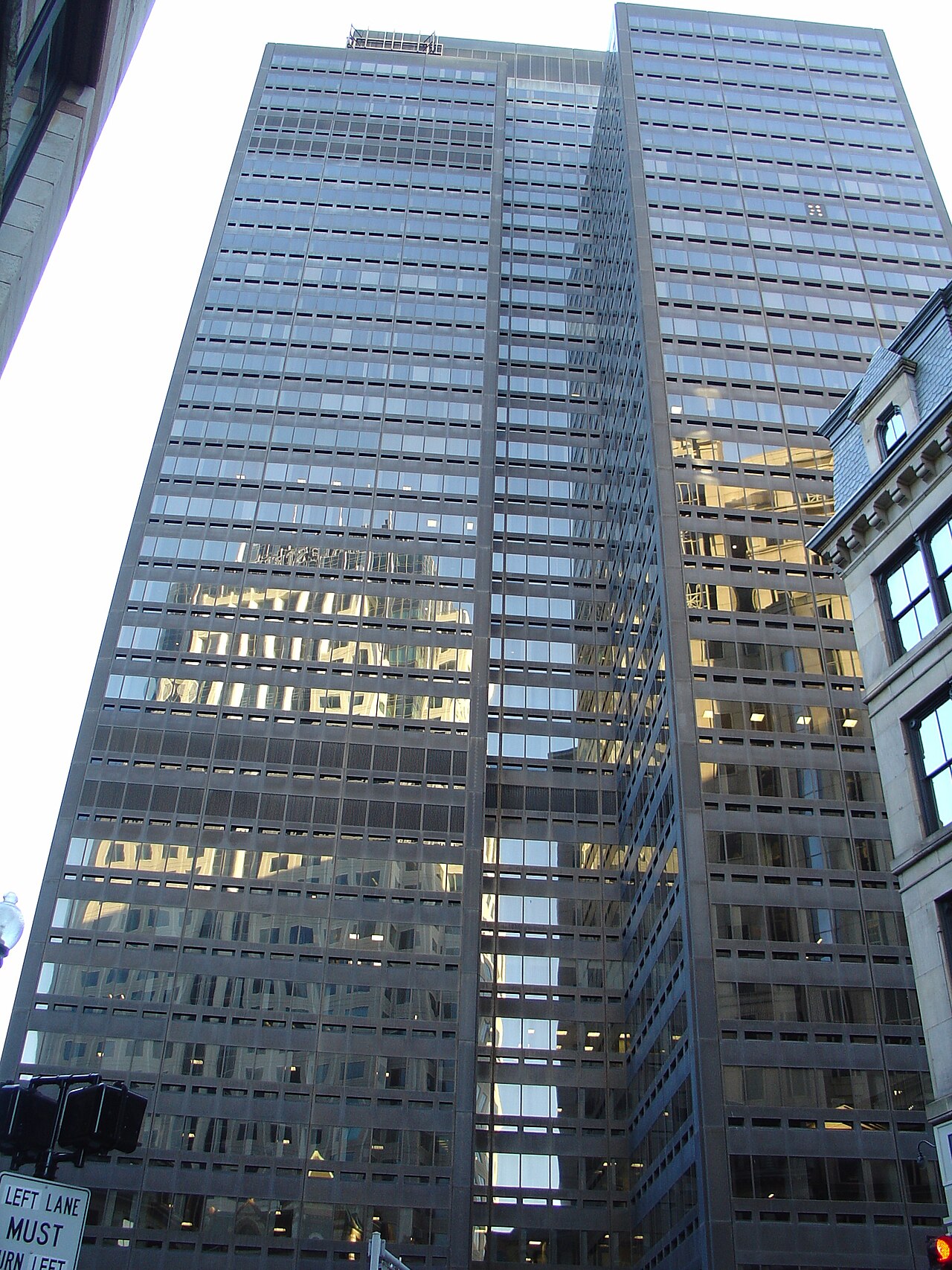
100 Summer Street stands at Summer and High in the Financial District, two blocks from South Station. [1] [6] It was completed in 1974 for Cabot, Cabot & Forbes, to a design by Welton Becket and Associates: 32 stories, a steel frame, a U-shaped footprint around a small public plaza, and bronze-tinted windows. [6] [12] The city's own filing puts the gross area at 1,135,045 square feet, of which 1,108,725 is office, 21,580 is enclosed parking, and 4,740 is a fast food restaurant. [9] Floor plates average about 39,000 square feet, and there are about 100 parking spaces below grade. [6] EQ Office acquired the building in 1998 and held it inside Blackstone's office portfolio until the sale to Rockpoint in October 2019. The owner of record going into the foreclosure is 100 Summer Owner LLC, Rockpoint's entity, which is also the name on the city's energy filings. [4] [9]
The value slide
The 2019 price was $806 million, about $779 a square foot on the floor area reported at the time, and the largest Boston commercial sale of its era. [4] Wells Fargo provided the $470 million mortgage alongside the purchase, which makes the implied equity check about $336 million. That last figure is arithmetic on the two published numbers, before fees and reserves, not a reported figure. [4]
The assessments tell the slide in the city's own numbers. The Boston Business Journal's analysis of the city's 20 largest office towers put 100 Summer at $529 million in fiscal 2024 and $488.6 million in fiscal 2025, a 7.6 percent drop and the second-largest dollar decline on the list. [8] Bisnow reported in September 2026 that the latest assessment pegs the value at about $425 million. The reporting does not name that figure's fiscal year, and this article does not assign it one. [3] On the published numbers, the latest assessment sits about 47 percent below the 2019 price and about $45 million below the mortgage as originated. On the city's figures, the debt exceeds the assessed value before any capital question is asked.
Commercial property taxes supply more than a third of Boston's tax revenue, the highest share among major American cities, per a 2024 Boston Policy Institute report, so a tower's assessment path is a city budget story. [7] Gregory Maynard of the Boston Policy Institute put it plainly: "This foreclosure shows that even prime office buildings are simply not worth as much as they were pre-COVID. High vacancies have persisted for years longer than after the Great Recession." [7]
The leasing record
In 2018 the building was about 95 percent leased or committed. Equity Office's leasing head said at the time that there was not enough swing space for Nixon Peabody to stay and renovate, and the firm left 167,000 square feet for 53 State Street. Rapid7, another major tenant, departed in the same period. [4] [8] Ironwood Pharmaceuticals then moved its headquarters in, WeWork took 117,000 square feet on three floors, and Industrious signed, all in the 2018 to 2019 run. [4]
WeWork's November 2023 bankruptcy filing listed its 100 Summer lease among the leases it asked the court to reject. Its two Boston targets totaled 118,000 square feet across 100 Summer and 40 Water Street combined, and the final disposition of the 100 Summer lease is not established in the public record. [3] Rockpoint's biggest win was SimpliSafe: a 150,000 square foot headquarters signed in 2021 and occupied from 2023, with at least $40 million of the tenant's own money planned for the build-out. [3] [10] The newest reported lease is the Massachusetts Trial Court's administrative offices, over 79,000 square feet on three floors on a 10-year term at a base rent of $64.77 a square foot, which is about $5.1 million a year in base rent by arithmetic. The report does not state when it was signed or when it starts. [4]
Today the auction notice says 72 percent leased, and the building's own listing shows more than 330,000 square feet available. [3] [6] The auctioneer reports the occupancy by stack: the mid-rise floors are 93 percent leased, the lower levels 84 percent, and the high-rise floors only 50 percent. [6] The auctioneer also says much of the occupancy comes from long-term tenants whose leases run into the 2030s, and one documented example fits: LendBuzz's lease on the 19th floor, filed with the SEC, runs to about 2030. [6] But no rent roll, weighted average lease term, or expiry schedule has been published. The full rollover picture sits inside the auction information package, gated to qualified bidders. [6]
The capital record
There is no engineering account of this building in the public record: no facility condition assessment, no owner condition statement, and no published evidence of a base-systems overhaul, HVAC plant, envelope, windows, or electrical, at any point in the tower's life. What is documented is interiors and amenities, concentrated in the run-up to the 2019 sale.
EQ Office's pre-sale program delivered a new lobby and an amenity center with a coffee bar, gaming areas, and a fitness center. Newmark's Edward Maher, selling for EQ, called it a transformation into a modern workplace and credited the upgrades with 600,000 square feet of leasing over the prior three years. No cost was published. [4] The elevator work in the same program was 21 cab interiors, etched glass, walnut veneer, and leather-clad bronze handrails. Cab interiors are not evidence about the elevator machines, controls, or hoistways. [11]
Against that record, read the auctioneer's 2026 voice as marketing, because that is what it is. Marianne Sullivan says the tower was "completely renovated in 2019," and that the common areas "offer a warm, modern, high-end aesthetic consistent with the caliber of tenants who occupy the building." [6] Her own pitch names the two value-add items that do not exist yet: "strong potential value-enhancement with the build-out of a rooftop deck and retail activation." A rooftop deck and activated retail are still potential in 2026, seven years after the renovation they were pitched alongside. [6] In the Rockpoint era, no owner capital program at 100 Summer is documented in any source reviewed. The documented capital of the era is tenant money, SimpliSafe's build-out. [10]
The market comparison is Bisnow's framing, and it is fair: at 101 Arch Street an owner ran a $20 million upgrade program, One Post Office Square completed a $300 million overhaul in early 2023, and International Place spent $100 million, and major leases followed at each. Those figures belong to other buildings. They are the demonstrated price of staying competitive in this submarket, not 100 Summer's budget. [3]
The energy record
The city knows this building well, because BERDO requires it to report. 100 Summer is BERDO ID 100009, its first compliance year was 2025, and its figures are owner-reported. The city says they are not independently verified. [9] For 2025 the owner reported total emissions of 3,603 metric tons and an emissions intensity of 3.2 kilograms of CO2e per square foot, with an ENERGY STAR score of 75. The office standard for 2025 to 2029 is 5.3, so the building is in compliance, and the disclosure says so. [9]
The office standard for 2030 to 2034 is also 3.2. On its own reported numbers, the building already sits exactly at the limit that binds it in 2030, with no cushion, and the standard keeps falling to zero in 2050. [9] About 45 percent of its reported emissions come from purchased district steam, a source whose carbon content the owner does not control. That share is arithmetic on the filing's own figures. [9] Emissions fell about 5 percent from the 2024 filing while total site energy rose, a reminder that grid and steam factors move these numbers without any building work at all. [9] BERDO's Alternative Compliance Payment is $234 a metric ton, the published price of missing a standard. The building owes nothing on its current numbers, so no payment figure belongs in a bid today. What belongs in a bid is the capital path that keeps it ahead of the step-downs. [9]
What a buyer has to price
The buyer's engineering diligence sets the capital number for a 1974 tower whose documented work stopped at interiors, because nobody else has published one. Filling the empty 28 percent, concentrated in the high-rise stack, will cost tenant improvements, commissions, and free rent at downtown's current concession levels. The anchors are genuine, SimpliSafe's 150,000 square feet and a new 10-year state lease among them, but the expiry schedule is a known unknown in a gated package. The energy position is compliant today and at the 2030 limit already, so the decarbonization conversation starts on day one. And the foreclosure deed itself carries a non-refundable $10 million deposit, terms the mortgagee can amend, and title and lien answers that come from the auction package, not the press. [1] [6]
One Lincoln hangs over the bidding as the market's only direct reference. That tower, also about 1.1 million square feet, sold to its own lender for $400 million at its March 2025 foreclosure auction, just over half its $763 million mortgage. It is a different building and a different loan, and it is still the number every bidder in the room has done the arithmetic against. [7]
No conversion plan for 100 Summer has been filed in anything located, and no source reviewed names the building in a conversion discussion. The city's Office to Residential Conversion Program is real, a 75 percent tax abatement for 29 years, with applications open through December 31, 2026 and construction starts committed by December 31, 2027. Against it stand two facts from this record: floor plates averaging about 39,000 square feet are deep plates of the kind conversion underwriters penalize for light and air, and conversion math usually starts from a mostly empty building, while this one is 72 percent leased with state and corporate anchors. That weighing is my analysis, built on the figures above.
My read
The foreclosure was in the arithmetic once the assessment crossed below the loan. A building the city values at about $425 million cannot refinance a $470 million balance on ordinary terms, and no capital plan changes that math by itself. The lender's behavior since September reads as a seller engineering a real auction rather than a formality: it postponed once, moved the deposit deadline to the day of the sale, and added five days to close. Each change lowers the cost of raising a hand.
What strikes me is how completely the capital question has been left for the buyer. The buildings around 100 Summer spent their way back to relevance and published the receipts. This tower's documented spending stopped at a lobby and elevator cabs in 2019, and its owner never published a number for the systems underneath. The discount on October 27 will look like the story. It is only the entry fee. The real price of this building is the bid plus the engineering bill nobody has published yet, and the bidder who prices both honestly is the one who actually owns the tower at a discount.
What the record does not show
No owner-published capital needs, deferred maintenance, or planned capital program figure exists for this building in the public record reviewed. Any number attached to its condition would be invented. The loan's current balance, interest rate, and maturity date were never published either: the $470 million is the 2019 origination figure, not a payoff amount, and the specific breach behind the foreclosure notice is not stated in any source reviewed. No opening bid, reserve price, or lender credit bid has been published.
No rent roll, weighted average lease term, or full expiry schedule is public. The auctioneer's stack percentages and the press-reported leases are what exist. The final disposition of the WeWork lease after its November 2023 rejection motion is not established, and the Massachusetts Trial Court lease's signing and commencement dates are not in the report that carries its size, term, and rent.
Boston permit history for base-building work was not pulled from the city portal for this analysis, so no claim is made about permits either way. Fee-simple ownership was not affirmatively verified against the deed: no ground lease is mentioned in any source reviewed, and the city lists a single parcel under the owner's name. And the auction outcome does not exist yet in the record: the sale is scheduled for October 27, 2026, and had not happened when this record was reviewed.